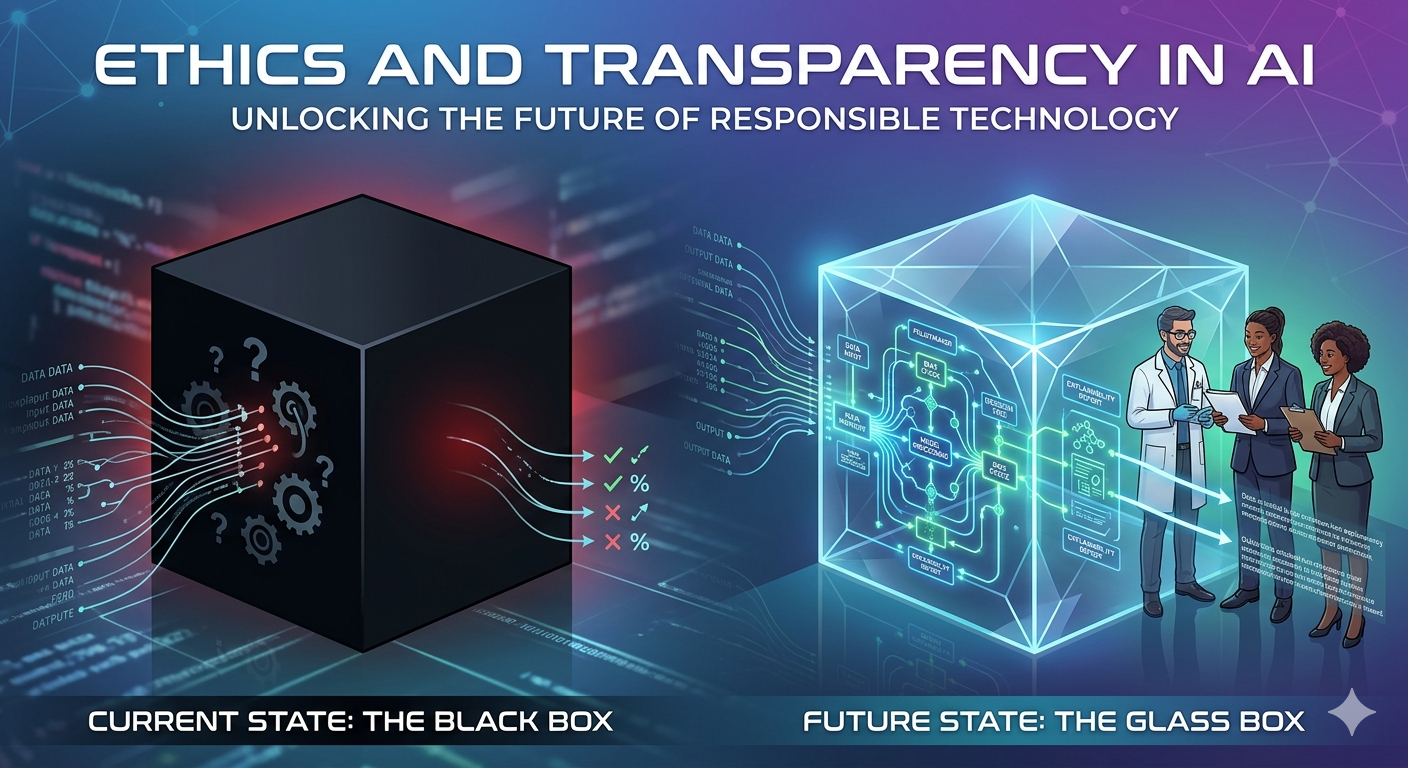

We have officially moved past the era of treating Artificial Intelligence as a futuristic novelty. Today, AI is the quiet engine running our world. It screens our resumes, determines who qualifies for bank loans, assists doctors in diagnosing illnesses, and shapes the information ecosystem we consume daily.
But as AI’s capabilities skyrocket, a critical question looms over the tech industry: Can we trust the machines we’ve built?
For too long, advanced machine learning models have operated as "black boxes"—systems that take an input and spit out an output with zero explanation of how they arrived at that conclusion. As AI becomes deeply embedded in human lives, this opacity is no longer just a technical challenge; it is a profound ethical risk. Building a sustainable digital future requires breaking open the black box and replacing it with a "glass box" built on two pillars: Ethics and Transparency.
The Core Ethical Dilemmas in Modern AI
When we talk about AI ethics, we aren't just talking about preventing a sci-fi robot uprising. We are talking about immediate, real-world harms that affect individuals every single day.
1. Algorithmic Bias and Discrimination
AI models do not think for themselves; they learn from historical data. If that data contains human biases, the AI will not only replicate those biases—it will amplify them at scale.
We have seen this play out in high-stakes scenarios:
- Hiring: Automated recruitment tools discarding resumes simply because they contain words associated with female candidates.
- Finance: Credit scoring algorithms granting lower credit limits to women or minority groups based on historical, systemic disparities.
- Justice: Predictive policing and sentencing tools outputting harsher risk scores for marginalized communities.
Without deliberate ethical intervention, AI becomes a tool that automates and legitimizes discrimination under the guise of "mathematical objectivity."
2. The Erosion of Privacy and Consent
To train the massive foundational models powering today's applications, tech companies have scraped billions of images, articles, and data points from the internet. This has sparked fierce ethical and legal battles regarding consent and intellectual property. When an AI app generates art or text based on the uncompensated, unconsented work of human creators, it crosses a dangerous ethical boundary. Furthermore, the constant harvesting of personal data for targeted algorithmic profiling threatens our fundamental right to privacy.
3. Misinformation and Social Manipulation
The rise of hyper-realistic deepfakes and automated text generators has made it incredibly cheap and easy to manufacture convincing misinformation. From political election interference to corporate sabotage, the ethical misuse of AI to manipulate public opinion poses a direct threat to social stability and democratic institutions.
Demystifying Transparency: Explainability vs. Disclosure
If ethical dilemmas represent the disease, transparency is a crucial part of the cure. However, transparency in AI is often misunderstood. It isn’t just about making thousands of lines of code open-source; it involves two distinct operational practices: Disclosure and Explainability.
                           ┌─────────────────────────┐
                           │     AI TRANSPARENCY     │
                           └────────────┬────────────┘
                                        │
                ┌───────────────────────┴───────────────────────┐
                ▼                                               ▼
   ┌─────────────────────────┐                     ┌─────────────────────────┐
   │       DISCLOSURE        │                     │     EXPLAINABILITY      │
   ├─────────────────────────┤                     ├─────────────────────────┤
   │ Knowing *when* you are  │                     │ Understanding *how* the │
   │ interacting with an AI  │                     │ AI reached its decision │
   └─────────────────────────┘                     └─────────────────────────┘
The Rule of Disclosure
Simply put, humans have a right to know when they are interacting with a machine. Whether you are chatting with a customer service bot, reading a news article generated by an LLM, or looking at a photorealistic image on social media, there should be clear, unambiguous labeling. Watermarking AI-generated media is no longer an optional courtesy—it is a societal necessity.
The Power of Explainable AI (XAI)
Explainability focuses on the internal mechanics of the model. If an AI system rejects a patient’s insurance claim or denies a user a loan, a human operator must be able to trace the decision-making process. Techniques in Explainable AI (XAI) aim to translate complex algorithmic weights into human-readable rationale. If we cannot explain why an AI made a decision, we cannot fix it when it goes wrong, nor can we hold anyone accountable.
Moving from Principles to Practice: A Roadmap for Responsible AI
Writing a list of ethical principles is easy; enforcing them across a global tech ecosystem is incredibly difficult. To move past performative ethics, organizations and developers must adopt actionable, defensible frameworks.
The Responsible AI Checklist:
- Data Minimization: Only collect and process data that is strictly necessary for the specific, transparent purpose of the model.
- Diverse Representation: Ensure data science teams and training datasets are diverse, reducing the likelihood of blind spots and baked-in bias.
- Continuous Auditing: AI models suffer from "data drift"—they can become less accurate or more biased over time as real-world conditions change. Regular, third-party ethical audits are vital.
- The Human-in-the-Loop: For high-stakes decisions in healthcare, law, and finance, AI should augment human judgment, not replace it. Ultimate accountability must always rest with a human being.
The Evolving Regulatory Landscape
The wild-west era of unregulated AI development is rapidly drawing to a close. Governments worldwide are stepping in to codify ethics and transparency into enforceable law.
The European Union's pioneering AI Act categorizes AI systems by risk level—banning outright manipulative technologies while imposing strict transparency and data-governance mandates on "high-risk" applications. In the United States, federal agencies are increasingly utilizing existing civil rights and consumer protection laws to prosecute companies deploying discriminatory algorithms.
For businesses, integrating ethical AI frameworks is no longer just about doing the right thing; it is about compliance and survival.
Conclusion: Trust is the Ultimate Currency
As we look toward the future, the companies and developers who win will not necessarily be the ones with the largest models or the fastest processors. They will be the ones who earn the trust of their users.
Technology is a reflection of its creators. If we build AI in the dark, using biased data and opaque algorithms, we will inherit a fractured digital landscape. But if we commit to radical transparency, rigorous ethical auditing, and human-centric design, we can transform AI from a unpredictable "black box" into an open, equitable tool that elevates all of humanity.
The choice is ours to make—and the time to build that glass box is now.
(Written by AI)